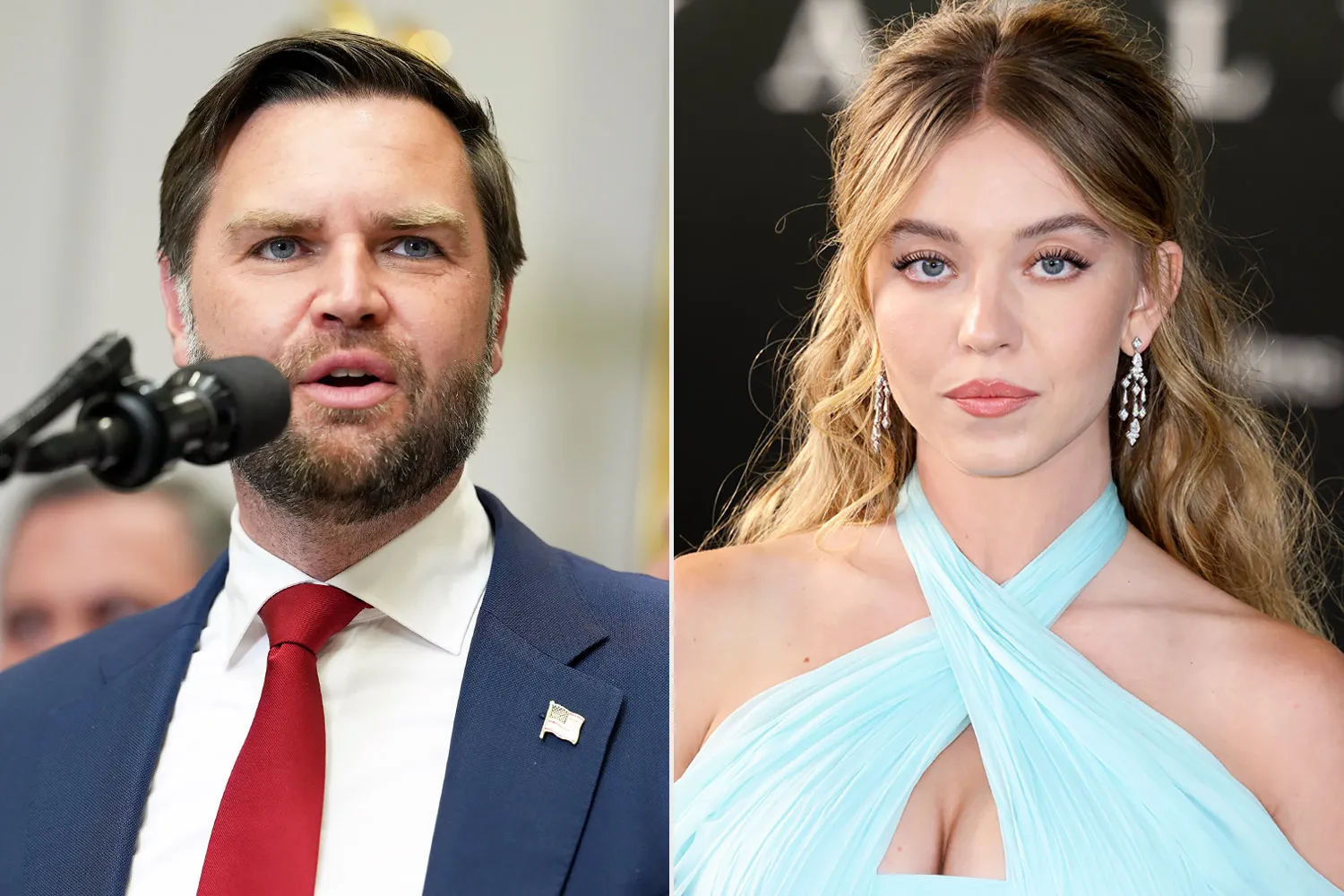
From fashion to political firestorm — how a jeans ad featuring Sydney Sweeney sparked cultural debate, conservative backlash, and accusations of coded messaging in America’s ongoing culture war
What began as a seemingly lighthearted fashion campaign has rapidly escalated into a national flashpoint, drawing the attention of politicians, cultural critics, and influencers alike. Sydney Sweeney, the 27-year-old Euphoria actress, became the unlikely epicenter of a fiery political and cultural debate following the release of her latest campaign with American Eagle, titled “Sydney Sweeney Has Great Jeans.”
The play on words—“great jeans” and “great genes”—initially seemed harmless, promoting denim with a tongue-in-cheek nod to the actress’s physical appeal. But as social media reactions swelled, critics accused the brand of echoing eugenics-era language and perpetuating ideals of white genetic superiority, especially given Sweeney’s blonde hair, blue eyes, and traditionally Eurocentric features. The controversy spiraled quickly, prompting responses not just from online commentators but from the upper echelons of American political life.
Among the most vocal was U.S. Vice President JD Vance, who weighed in during a recent episode of the Ruthless podcast. His remarks were blunt:
“My political advice to the Democrats is continue to tell everybody who thinks Sydney Sweeney is attractive is a Nazi,” Vance said. “That appears to be their actual strategy.”
Vance criticized what he views as a Democratic tendency to politicize everyday aspects of American life. “You have a normal, all-American beautiful girl doing a normal jeans ad,” he remarked, “and they have managed to so unhinge themselves over this thing. Did you learn nothing from the November 2024 election?”
The ad features Sweeney wearing a denim jumpsuit and delivering the line, “My body’s composition is determined by my genes (jeans),” which some critics interpreted as evoking racially charged rhetoric. Social media influencer @jessbritvich was among the first to draw parallels to language used by Donald Trump in 2020 when speaking about “good genes” to an overwhelmingly white crowd in Minnesota.

“In this ad,” she said, “it’s saying Sydney has a great body and therefore great genes—a product of genetic superiority… It’s echoing the language of white purity politics.”
The response from conservative circles was swift and scathing. Alongside Vance, White House communications director Steven Cheung and TV host Megyn Kelly also denounced the backlash, characterizing it as yet another example of progressive overreach. “So much of the Democrats is oriented around hostility to basic American life,” Vance said. “You have a pretty girl doing a jeans ad, and they can’t help but freak out. It reveals a lot more about them than it does us.”
Notably, as CNN White House producer Alejandra Jaramillo pointed out, no prominent Democratic Party leaders or elected officials have commented on the ad, raising questions about whether this debate is being fueled more by conservative media than actual bipartisan disagreement.

A Media Matters study further highlights the disparity in coverage. Since the controversy broke, Fox News has spent over 85 minutes discussing the ad, dwarfing coverage on other cable networks. While social media has been alight with op-eds, reaction videos, and satire—including a mocking TikTok reenactment by Doja Cat in an exaggerated backwoods accent—mainstream news and Democratic lawmakers have largely stayed silent.
Doja Cat’s satirical take added yet another layer to the unfolding drama. By reciting Sweeney’s lines in a contrasting, comedic tone, she amplified the absurdity of the entire situation while also subtly critiquing the aesthetic messaging of the original ad.

Despite the storm, neither Sydney Sweeney nor American Eagle has issued a formal statement. Their silence has allowed both sides of the cultural aisle to project their interpretations onto the campaign—turning a denim commercial into a symbol of deeper societal rifts.
At its core, the controversy exposes a growing fracture in American public discourse: the tension between marketing, identity politics, and cultural symbolism. Whether one sees the ad as an innocent play on words or a problematic dog whistle, the intensity of the debate signals a climate where even fashion ads can ignite full-blown political discourse.
As the conversation evolves, it remains to be seen whether this controversy will fade like many viral moments—or mark a turning point in how brands navigate the increasingly politicized landscape of cultural messaging.